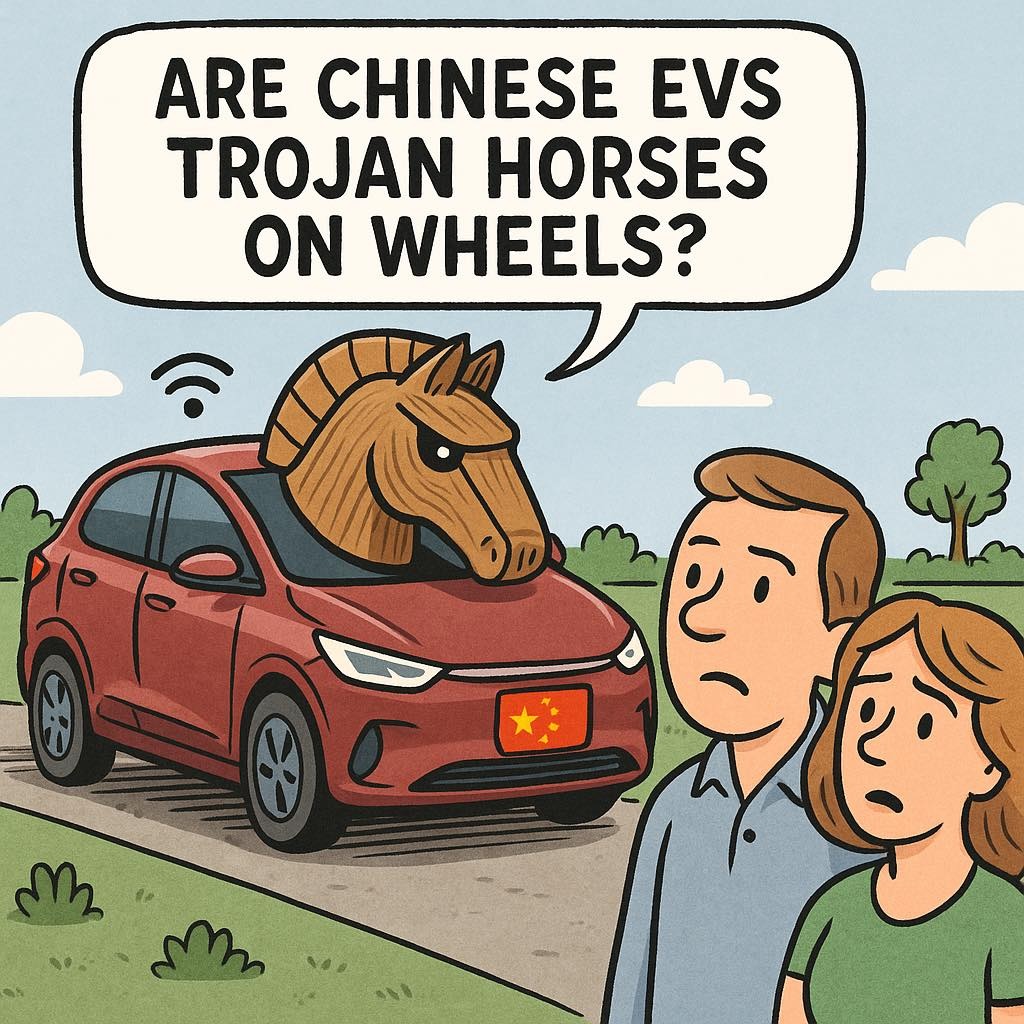
Chinese electric vehicles are the latest bargain forcing Australia to choose between cheaper household technology and national control.
The surface story is easy to understand. Families want affordable electric cars, Chinese brands are offering them, and Australian showrooms have become the pressure point where cost of living meets climate policy.
BYD and MG are no longer fringe brands in this country. One in four electric vehicles sold here last year was a BYD, Tesla’s Australian models mostly come from Shanghai, and with no tariffs like the United States or Europe, Chinese-made cars have moved quickly into the Australian market.
For many buyers, the calculation is not ideological. A cheaper electric vehicle means a family can move into the EV market sooner, avoid higher fuel costs, and get a newer car with features that once sat in more expensive Western models.
Price is the visible attraction, but software is the hidden risk.
Alastair MacGibbon, Australia’s former national cybersecurity adviser and now Chief Strategy Officer at CyberCX, has warned that Chinese electric vehicles are not just cars. At the AFR Cyber Summit, he described them as “listening devices” and “surveillance devices in terms of cameras.”
His point is not that every buyer is making a foolish choice. His point is that modern vehicles carry cameras, microphones, Global Positioning System tracking, Bluetooth connections, telemetry systems, and internet links that can collect and transmit information well beyond what most people imagine when they think of a car.
MacGibbon has also warned that vehicle software could be manipulated to disable safety systems or create battery risks. On the ABC, he pointed to the ability to turn on microphones and cameras as vehicles move through streets, car parks, workplaces, schools, military bases, and private driveways.
Modern cars have become rolling sensors, and Australia still talks about them as consumer appliances.
Lieutenant General Michelle McGuinness, Australia’s National Cyber Security Coordinator, has taken a similar view. In October 2024, she said concerns about electric vehicle hacking were justified and explained that, in her own family, decisions about trusted devices were made carefully.
Her warning matters because she is not a commentator chasing a headline. She is a senior intelligence professional responsible for helping coordinate Australia’s cyber defences, and her argument is that connected technologies need stronger standards before risk becomes normalised.
The national problem sits in the gap between private choice and public exposure. A family can decide whether a cheaper Chinese EV makes sense for its own budget, but the vehicle does not stay inside that private frame once it is collecting location data, pairing with phones, entering secure areas, or sending telemetry to overseas systems.
Chinese law requires local companies to cooperate with intelligence requests. That does not prove that a Chinese-made car in Australia has been used for spying or sabotage, but it changes the risk calculation when the product is connected, mobile, data-rich, and made by companies subject to Beijing’s legal system.
Other countries are not treating the question as imaginary.
The United States Commerce Department has described modern cars as “smartphones on wheels” and warned that hostile states could disable or manipulate vehicles at scale. Commerce Secretary Gina Raimondo put the fear plainly: imagine an enemy shutting down thousands of vehicles at once.
Israel’s Defence Force has reportedly disabled built-in mobile chips in Chinese cars used by officers so data could not leave the vehicles. In the United Kingdom, some defence staff have been told not to pair their phones with Chinese-made cars.
Australia’s position is less clear. Energy Minister Chris Bowen has ruled out a ban and framed the issue around consumer choice, while Home Affairs Minister Tony Burke, who owns a Chinese electric vehicle, told parliament he had taken “appropriate precautions” after departmental advice.
Those precautions have not been made public. The Department of Home Affairs says it is monitoring what the United States is doing, but Australians still do not have a clear national policy that explains which risks are acceptable, which settings should apply, and which environments should be off limits.
Caution does not require panic, but uncertainty is not a policy.
Sceptics have a serious case. There is no public proof that a Chinese electric vehicle has been used in Australia to spy, disable safety systems, or cause harm, and phones, drones, smart televisions, and other connected devices already collect sensitive information.
Some also argue that China would risk damaging its booming auto export industry if it crossed the line. Others suspect the pushback in the United States and Europe is partly about protecting domestic car industries rather than pure security.
Those objections should not be dismissed. National security debates often attract convenient fear, and industrial policy can dress itself up as protection when old manufacturers face cheaper competition from a new rival.
Australia’s problem is that both things can be true at once. Chinese electric vehicles can be excellent value for families, and still create a security problem when deployed at scale across a country with no domestic car industry, no settled screening regime, and no clear rules for sensitive users or locations.
Chris Uhlmann and Steve Lewis imagined a related danger more than a decade ago in The Marmalade Files. Their political thriller turned on foreign powers exploiting Australia’s mobile telecommunications networks for access and advantage, a fictional warning that now feels less like melodrama and more like a policy rehearsal.
The technology has changed from phone towers to four wheels, but the political weakness is familiar. Australia loves the benefit of imported systems, then hesitates when someone asks who controls the pipes, the code, the updates, the data, and the kill switches.
Affordable Chinese EVs help households solve a real cost problem. They also help Australia move towards cleaner transport without waiting for expensive Western brands to bring prices down.
Yet sovereignty is rarely lost in one dramatic moment. It more often leaks through ordinary purchases that look sensible one driveway at a time.
Australia does not need to ban every Chinese-made electric vehicle to take the risk seriously. It does need a clear position on data, software updates, sensitive sites, government use, phone pairing, mobile chips, national standards, and what happens when the cheapest option also carries the most complicated trust problem.
Families should not have to solve national cyber policy at the dealership.
Chinese electric vehicles may turn out to be mostly bargain, mostly risk, or some awkward mix of both, but Canberra cannot keep pretending the answer will reveal itself after the cars are already everywhere.