Australia’s original promise to returned service people was brutally simple: if you send them, and you bend them, you mend them.
After World War I, that principle was written into Commonwealth machinery. The Repatriation Department was created in 1917 to support returned soldiers with pensions, rehabilitation, medical care and housing. The name and structure changed over time, from the Department of Repatriation and Compensation in 1974, back to the Department of Repatriation in 1975, then into the Department of Veterans’ Affairs (DVA) in 1976.
The duty was not meant to change with the letterhead.
Australia accepted that military service created a national debt when people came home damaged by that service.
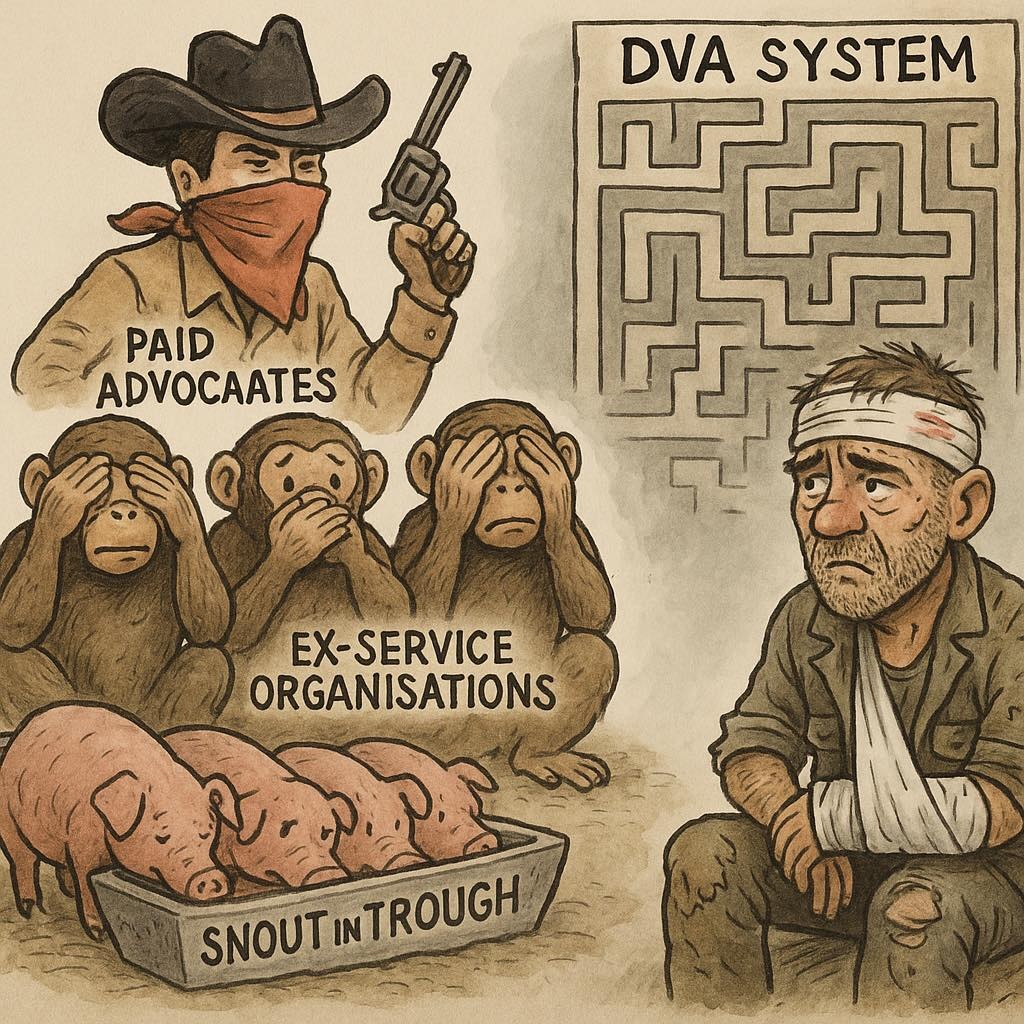
DVA now manages more than twelve billion dollars each year to support veterans and their families. In theory, that money should sit around the veteran: compensation for injury, rehabilitation, treatment, income support, and practical help for those carrying the cost of service. In practice, too many veterans meet the system as a maze before they meet it as care.
Veterans are not just dealing with one scheme, one doorway, or one clear path to support.
Claims are split across the Veterans’ Entitlements Act 1986 (VEA), the Safety, Rehabilitation and Compensation Act 1988 (SRCA), the Defence-related Claims Act 1988 (DRCA), and the Military Rehabilitation and Compensation Act 2004 (MRCA). Each law carries different dates, tests, thresholds, documents, review processes and meanings. A veteran with post-traumatic stress disorder, chronic pain, disability, or a collapsing family life does not experience that as policy architecture. They experience it as another burden.
Complexity becomes part of the injury when the person seeking help is already worn down.
Ex-service organisations were supposed to help veterans through that burden. Many still do good work at ground level. But the sector has also become entangled with access, status and government process.
Many ex-service organisations sit around the Department of Veterans’ Affairs Ex-Service Organisations Round Table (ESORT). That access gives them a line into the department. It also gives them a reason to protect the relationship.
Critics argue that some organisations become careful with their public criticism because they do not want to lose their seat at the table. That is the danger when representation turns into managed consultation. The organisation starts measuring its influence by access to the department rather than by pressure applied for veterans.
A veterans’ system loses moral force when the insiders become too comfortable.
The phrase “snout in the trough” is ugly, but it captures the anger many veterans feel when organisations built to represent them appear more invested in their own standing than in public confrontation. The issue is not whether every ex-service organisation is corrupt or useless. That would be too broad and too easy. The real issue is whether the structure rewards caution, insider language and relationship management when veterans need blunt advocacy.
That gap has helped create the space now occupied by paid advocates.
Private advocates are not new, and not every veteran sees them as the enemy. Some veterans defend them because official channels are slow, volunteer advocacy is stretched, and the system is too hard to navigate alone. When a person feels abandoned by the very machinery meant to help them, a paid operator who promises to cut through the red tape can look less like a profiteer and more like the only working door.
That is exactly why the conflict matters.
Many paid advocacy models rely on large fees or commissions drawn from compensation payouts. The bigger the payout, the bigger the payday. That creates a direct tension between the veteran’s wellbeing and the advocate’s financial interest.
A support system should not make a wounded veteran the raw material for someone else’s business model.
Some paid advocates may be competent, disciplined and useful. Others are described by veterans and critics as cowboys or opportunists. Both things can be true at once. A broken public system creates a market for help, and an unregulated market creates room for exploitation.
The deeper failure is that anyone can call themselves an advocate.
A veteran seeking help with a life-shaping claim may not know whether the person advising them is properly trained, insured, supervised, ethical, or accountable. That is not a small gap. It is a structural failure in a system dealing with vulnerable people, public money, and injuries created by national service.
Darren Chester, the Nationals MP for Gippsland and former Minister for Veterans’ Affairs, has been one of the more consistent critics of the system, including the portfolio he once managed. He has called for commission-based advocacy to be banned, advocates to be licensed, and frontline support services to receive proper funding. Those calls sit alongside the Royal Commission into Defence and Veteran Suicide, which documented harm caused by slow processes and complex laws.
Parliament has now passed the Veterans’ Entitlements, Treatment and Support (VETS) Act. From July 2026, the VEA and DRCA will close to new claims, with all new cases to fall under the MRCA. Supporters say the change will harmonise the system and reduce confusion.
Many veterans hear something else.
They hear governments promising simplification while protecting the budget. They hear redesign language that may or may not translate into better outcomes. They hear reform, but they remember delays, forms, reviews, thresholds, knockbacks and the long grind of proving damage to the institution that already knows what service can cost.
The question is not whether harmonisation sounds tidy on paper.
The question is whether the veteran will face fewer traps, fewer delays, fewer conflicting rules, and fewer reasons to seek help from people who take a cut of compensation. If the 2026 reform merely repackages complexity under a cleaner label, it will not restore trust. It will just give the maze a new sign at the entrance.
Australia’s obligation has never been hard to state.
Service people were sent by the nation. Some came home changed, injured or broken. The duty is to mend them without making them fight a second campaign against bureaucracy, insider caution, or paid middlemen.
Veterans are not a neat lobby group, a departmental workload, or a budget pressure to be managed.
They are men and women who served because their country asked them to. If they come home injured, the obligation is not optional, symbolic, or subject to clever process design. It is absolute.
A veterans’ system worthy of the name would be simple, fair and centred squarely on the person who served, not the bureaucracy, not the organisations, not the advocates, and not the budget.